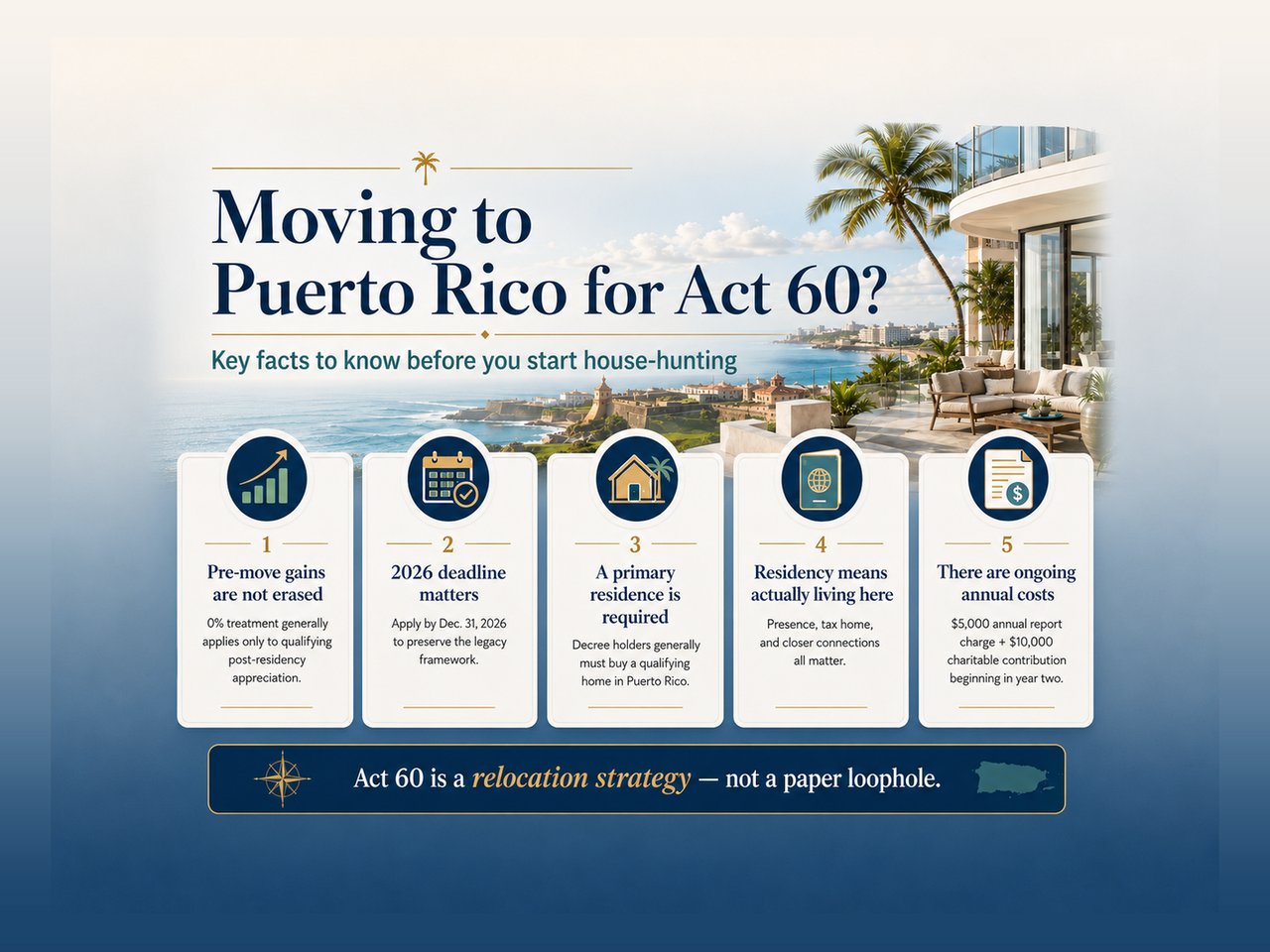
Moving to Puerto Rico for Act 60? Read This Before You Start House-Hunting
Puerto Rico continues to attract investors, entrepreneurs, and professionals interested in the potential benefits available under Act 60.
The opportunity is real, but Act 60 is not a magic switch. It requires careful planning, genuine relocation, and ongoing compliance.
Following the approval of Act 38-2026, timing has become even more important for anyone considering a move to Puerto Rico. Before beginning a property search, here are five important limitations every prospective Act 60 applicant should understand.
1. Act 60 Does Not Eliminate Gains You Already Have
One of the most common misconceptions is that moving to Puerto Rico automatically eliminates taxes on investments you already own.
It does not.
The preferential treatment generally applies to qualifying income and appreciation generated after establishing bona fide residency in Puerto Rico. Appreciation accumulated before the move remains subject to separate federal and Puerto Rico tax rules.
This distinction may be especially important for people holding:
- Cryptocurrency
- Publicly traded stocks
- Private-company equity
- Investment funds
- Appreciated business interests
- Other investment assets
The timing of your relocation, residency date, decree application, and future asset sales can significantly affect the outcome. These decisions should be coordinated with qualified tax and legal professionals before selling or restructuring investments.
2. The Current 0% Application Window Is Closing
Act 38-2026 created an important dividing line for new applicants.
Applications Submitted by December 31, 2026
Qualified applicants who submit their decree applications on or before December 31, 2026, may remain under the existing framework, which provides a 0% Puerto Rico tax rate on certain qualifying interest, dividends, and post-residency capital gains through December 31, 2035.
The relevant date is generally when the application is submitted, not when the decree is ultimately approved.
Applications Submitted Beginning January 1, 2027
Applications submitted on or after January 1, 2027, will fall under the revised framework.
The new structure generally includes:
- A 4% Puerto Rico tax rate on qualifying investment income
- Potential benefits through December 31, 2055
- A six-year Puerto Rico non-residency requirement before relocating
The 4% rate may still be attractive, but it is a different financial arrangement from the framework available to qualifying applicants who file during 2026.
The deadline is not a reason to rush into a decision. It is a reason to begin planning early.
3. Purchasing a Primary Residence Is a Legal Requirement
For individual resident investors, purchasing a home in Puerto Rico is not merely a lifestyle decision. It is part of the compliance requirements.
A decree holder must generally purchase residential property in Puerto Rico to serve as a primary residence within two years after receiving the decree and maintain qualifying ownership during the applicable term.
The precise ownership requirements may vary depending on the filing date, decree terms, marital status, and ownership structure.
The property therefore needs to serve two purposes:
- Satisfy the applicable legal and compliance requirements.
- Support the lifestyle the individual genuinely intends to establish in Puerto Rico.
That could mean a condominium in metropolitan San Juan, a residence in Dorado, a property in Palmas del Mar, or a home near Río Grande and the northeastern coast.
The right property should be based on how the buyer intends to live—not simply which home appears most attractive online.
4. Residency Means Actually Living in Puerto Rico
A Puerto Rico address, local driver’s license, property purchase, or Act 60 decree does not automatically establish bona fide residency for federal tax purposes.
The IRS generally evaluates three major requirements:
- The presence test
- The tax-home test
- The closer-connection test
Spending at least 183 days in Puerto Rico is the most familiar way to satisfy the presence test, but it is not the only method recognized under federal rules.
Regardless of the method used, the individual’s tax home and personal, professional, and economic connections must support the position that Puerto Rico is genuinely their primary home.
Relevant factors may include where the individual:
- Maintains a permanent residence
- Conducts business
- Spends most of their time
- Registers to vote
- Holds licenses
- Maintains banking relationships
- Participates in community life
- Keeps their closest personal and professional connections
The IRS continues to examine taxpayers who claim Puerto Rico tax benefits without properly satisfying the federal residency and income-sourcing requirements.
Paperwork may support residency, but it does not replace residency.
5. Act 60 Includes Significant Annual Costs
The tax benefits are accompanied by recurring compliance obligations.
An individual resident investor is generally subject to a $5,000 annual charge connected with the required annual reporting.
Beginning with the second taxable year after receiving the decree, the decree holder must also provide evidence of an annual charitable contribution of at least $10,000 to qualifying nonprofit organizations operating in Puerto Rico.
These amounts do not include other potential expenses, such as:
- Attorney fees
- CPA and tax-planning fees
- Application and processing costs
- Annual tax-return preparation
- Real estate acquisition expenses
- Property insurance
- Homeowners’ association fees
- Property taxes
- Relocation and household expenses
A serious relocation plan should account for the full annual cost of compliance—not only the advertised tax rate.
Act 60 Is a Relocation Strategy, Not a Paper Loophole
Act 60 can be a powerful incentive for the right person, but it rewards those who plan carefully, relocate genuinely, and comply with both Puerto Rico and federal requirements.
It should not be viewed as a loophole or a strategy that works simply by purchasing property and filing paperwork.
The home-purchase requirement also makes real estate an important part of the relocation process. The property should be selected in coordination with the buyer’s overall legal, financial, and lifestyle plan—not treated as an afterthought once the tax planning is complete.
Before beginning a home search, prospective applicants should understand:
- Where they intend to live
- How much time they will spend in Puerto Rico
- What type of property supports their lifestyle
- Their expected relocation timeline
- How the purchase fits within the guidance provided by their tax and legal advisors
Important Disclaimer
This article is provided for general informational purposes only and should not be interpreted as legal, tax, accounting, financial, or investment advice.
Act 60 eligibility, income sourcing, residency, decree terms, application deadlines, ownership structures, and compliance requirements depend on each person’s circumstances and may change.
Anyone considering relocation, an Act 60 application, the purchase of property, or the sale of investment assets should confirm the current requirements with qualified Puerto Rico legal counsel, a licensed CPA, and the appropriate government agencies before making financial or relocation decisions.